
Basics of 3D Printing
3D printing (also known as Additive Manufacturing) is the process of making 3D physical objects from a digital file by successively adding layers of material via a 3D printer. By using an additive process, 3DP is the opposite of conventional subtractive manufacturing methods where material is successively cut away from a solid block. The difference between a subtractive process and an additive one is schematised in the below picture.

Subtractive process (on top) vs. additive process. Source: http://ludoreng.com/
Available 3D printing technologies
There are many 3DP technologies available today, using various types of materials (solid (sheet, filament, pellet), liquid, powder, slurry) and different approaches.
Stereolithography (SLA) creates objects by selectively curing a resin layer-by-layer using a light source (a laser or projector). Digital Light Processing (DLP) is very similar to SLA except DLP uses a digital light projector to flash a single image of each layer all at once. Selective Laser Sintering (SLS) use a laser which selectively induce fusion between powder particles inside a build area to create a solid object. Many other 3DP technologies exists and new ones are still developed.
However, most of them are too complicated and too expensive to be considered in the education of low-skilled adults. The most popular and most affordable 3DP technology is Fused Deposition Modelling (FDM). In addition, FDM is easy to use and very suitable for adult education. Consequently, this module will focus on FDM.
FDM lays down consecutive layers of material at high temperatures, allowing the adjacent layers to cool and bond together before the next layer is deposited.
FDM technology. Source: http://ludoreng.com/
3DP workflow
3DP normally involves the use of a computer, a digital 3D model, software for 3D model preparation, a 3D printer and raw material.
First, the 3D model of the object to be printed is needed. This have to be processed in order to obtain a file that can be used by the 3D printer. Usually, this means converting the 3D model in a .stl file, if necessary, and slicing the .stl file into a set of 2D sections using a slicer software. The slicer software is also setting the 3D printing process parameters and, at the end, generates a file containing all the instructions needed by 3D printer to complete the job. This file (usually a .gcode file, i.e. a file containing commands in G-Code, which is a language 3D printers can read) is fed into the 3D printer which then lays down successive layers of molten material to fabricate the part. A typical 3DP workflow is schematized in the below picture.

Typical 3D printing workflow. Source: Ludor Engineering
Obtaining 3DP models
There are several ways to obtain a 3D model for 3DP: by 3D modelling using a suitable software, by 3D scanning or by downloading it from a specialised online repository.
There are many software available for creating 3D models, including some free ones, for all levels from beginner to professional. Some of them are given in the below table. In addition, there are a lot of educational resources and tutorials that can be used to learn how to create your own 3D models. 3D modelling is an indispensable skill when you want to create your own objects.
*Free for students and educators
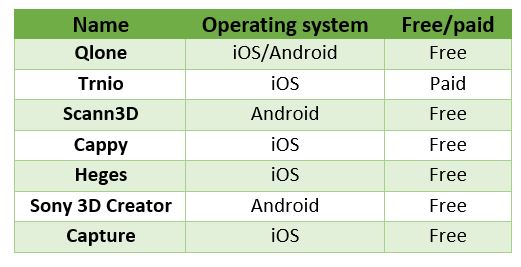
3D scanning is a method used to capture the shape of an object by using a 3D scanner or a smartphone with a suitable application. 3D scanning apps are based on photogrammetry, a technology that creates 3D models from 2D photos taken from different angles, which are then “stitched” together by a software. Some 3D scanning apps are given in the below table.
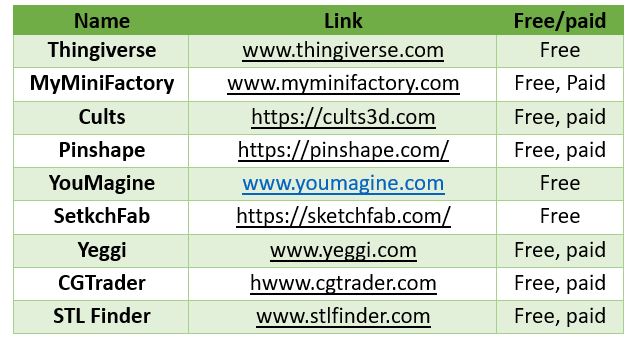
The simplest way to obtain a 3D model for 3DP is to download it from one of the many available online repositories. Many of these models are free. Some of the best such repositories are given in the table below.
3D printing slicer software
Slicers are software that take 3D model (most often in .stl format), divide it into multiple layers, include 3D printer settings (like temperature, layer height, print speed, etc.) and generate the G-code file that provides the directions needed by the 3D printer to make the object. There are many slicers available and most of them are free. Some of the most popular slicers are given in the table below.

FDM 3D printers
A FDM 3D printer uses continuous filament, which is fed through a gear mechanism into a heater that heats it up and melts it. Then, the molten filament is ejected from the nozzle onto the print bed in the desired geometry. After each layer, the print bed (or the nozzle) moves on the vertical axis and the next layer is added until the object is completely 3D printed. The process is schematised in the bellow figure.

FDM process. Source: Ludor Engineering
The main components of a FDM 3D printer are:
- The frame – holds all other parts of 3D printer together. It can be made of sheet metal, aluminium, plastic, plywood or even 3D printed.
- Print bed – the surface on which the objects are printed. It can be heated, which is a very useful feature for avoiding object warping and peeling off the bed during printing process.
- Extruder – an essential part having two parts: the cold end with motor, which draws the filament in and pushes it through, and the hot end where the filament is melted and ejected out.
- Head movement mechanics – there are several types, the most common being:
- Cartesian – printers have rectangular frame wherein any movement can happen along one of three perpendicular axes: X, Y or Z.
- Delta – the extruder is held by three arms in a triangular configuration and the print bed is usually circular and does not move.
- Polar – use polar coordinate system, where positioning is determined by an angle and a length.
- Robotic arm.
- Stepper Motors – used for precise position control.
- Electrical components: power supply, motherboard, stepper drivers, SD card slot, user interface.

- Main components of a FDM 3D printer. Source: Ludor EngineeringFDM 3D printers can by classified in two main groups: industrial and desktop 3D printers. Desktop FDM 3D printers are suitable for prototyping and low-volume production while the industrial ones are employed for fully functioning high quality parts, with big size, high accuracy and elevated material properties. The major differences between desktop and industrial printers are the associated costs and the production capabilities, as can be seen in the below table.

Source: https://www.3dhubs.com/knowledge-base/industrial-fdm-vs-desktop-fdm/

Industrial FDM 3D printer. Source: Ludor Engineering

Desktop FDM 3D printer. Source: Ludor Engineering
3DP materials
FDM 3DP uses continuous filament of thermoplastic, a material that melts when heated at a certain temperature and solidifies when cooled. The filaments come in different types, usually on spools of different sizes and weights. Two filament diameters are commonly used: 1.75 mm (the most popular) and 3 mm/2.85 mm.

3D printing filament used in FDM. Source: Ludor Engineering
There are many types of filament that can be used by FDM 3D printers. The most popular are PLA and ABS. PLA is the filament of choice for hobby 3DP due to its good characteristics and low price. ABS is also cheap and can be used for making functional parts. For more demanding applications, materials like Polycarbonate (PC), Nylon and PETG can be used. PC is useful for high temperature applications and it is stronger than both PLA and ABS but yet flexible. Nylon offers high flexibility and great strength while being extremely lightweight. Printed Nylon parts are not as brittle as those printed with either ABS or PLA, so they can be 10 times stronger without cracking or breaking. PET is the most commonly used plastic in the world and its variants PETG and PETT are often employed in 3DP. PETG combines the strength, temperature resistance and durability of ABS with the ease of use of PLA while PETT is strong and can be food-safe and transparent.
Some special types of filament, soluble in water or other substance, are used for creating support structures which are necessary when the printed part has overhangs or features suspended in air, like in the example from the below picture.

Support structures (in red) and the 3D printed part (in blue). Source: Ludor Engineering
A 3D printer with two nozzles is normally used, one printing the part with normal filament and the second printing the support structures. The part is then placed in the dissolving substance until all supports are dissolved. Such materials are PVA (water-soluble material, used as support with PLA material) and HIPS (that dissolves in limonene solution and is used as support with ABS material).

PVA used as support. Source: filamentguide.net
Thermoplastic Elastomers (TPE) can be used to 3D print flexible objects like footwear or drive belts. TPU (Thermoplastic Polyurethane) is one of the most used types of TPE.

Footwear 3D printed in TPE. Source: Adidas
Composite filaments made from polymers reinforced with metals, glass, carbon, ceramics, etc. are also used in FDM.
PEEK and PEI are materials with exceptionally high mechanical, thermal, and chemical resistant properties that are maintained at high temperatures. However, they need to be 3D printed on 3D printers with high capabilities (able to handle temperatures above 400 °C).
The wide range of filaments available in FDM can be divided in 3 main groups: standard thermoplastics, engineering materials and high-performance thermoplastics.

The pyramid of FDM materials. Source: Ludor Engineering
The most common FDM materials are in 3DP summarized in the table below together with some indications about their characteristics.

3DP advantages and limitations
3DP has some important advantages:
- Single step fabrication – unlike traditional technologies that usually require a large number of manufacturing steps to produce a part, 3DP completes a part in one step.
- No need for tooling – 3DP does not need moulds, jigs or other tooling and, so, it is very convenient for production of unique parts or small batches.
- Efficient customization – the customization of a product by 3DP requires only the modification of its 3D file so there is virtually no additional costs.
- Freedom of design and complexity – very complex shapes and geometries, sometimes impossible or very expensive to achieve with other methods, can be obtain by 3DP.
- Print on demand – by storing the digital 3D models of the parts and 3D printing them only when needed, the space needed to stock inventory and the costs are reduced.
- Fast production – depending on a part’s design and complexity, it is much faster to 3D print it than to obtain it through machining or moulding.
- Waste minimisation – as an additive technology, 3DP produce little or no wastage.
However, 3DP has also limitations:
- Reduced range of materials that can be 3D printed – they are mostly plastics.
- Restricted size of parts that 3D printers can produce.
- Expensive, for large volumes of fabrication – the cost per 3D printed part remains constant regardless of the number of parts produced while for traditional manufacturing methods the unit cost decreases with the increase of the production run. Consequently, 3DP can be more economical for a small batch but more expensive as the production run increases.
- Low strength and endurance – the 3D printed parts are often weaker than their traditionally manufactured equivalents.
- Low accuracy and low surface quality.
- 3D printers are slow.
3DP applications
3DP is a very easy, affordable and rapid method for producing prototypes thus allowing for faster development of products.

A prototype made using 3DP. Source: Ludor Engineering
3DP, especially FDM, can produce prosthetics at low costs and in a short time.

A 3D printed hand. Source: StarWarsRey, Star Wars Bionic hand, CC BY-SA 4.0C

FDM 3D printers are used in education, at all levels, from kindergartens to adult education.

3D printed robot hand for educational purposes. Source: Ludor Engineering
3D printed architectural models can be rapidly produced at a fraction of the cost required by traditional techniques.

A 3D printed architectural model. Source: Ludor Engineering
FDM can produce strong and functional parts for a wide range of industrial and domestic uses.
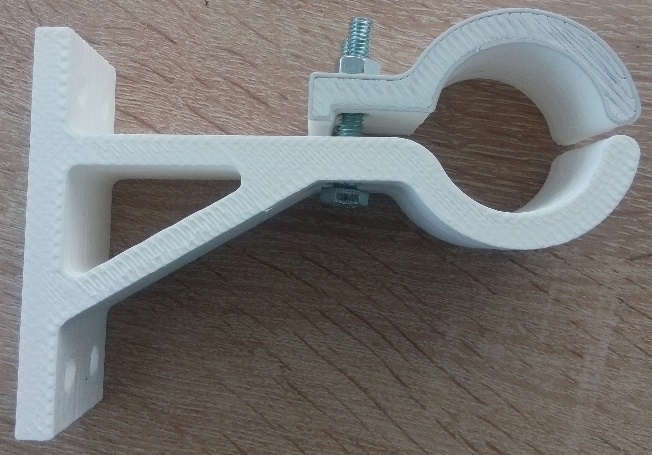
3D printed functional part. Source: Ludor Engineering
FDM is suitable for both industrial and domestic use. Household applications includes creating objects, repair parts and tools needed at home.

Home tool made by 3DP. Source: Ludor Engineering